




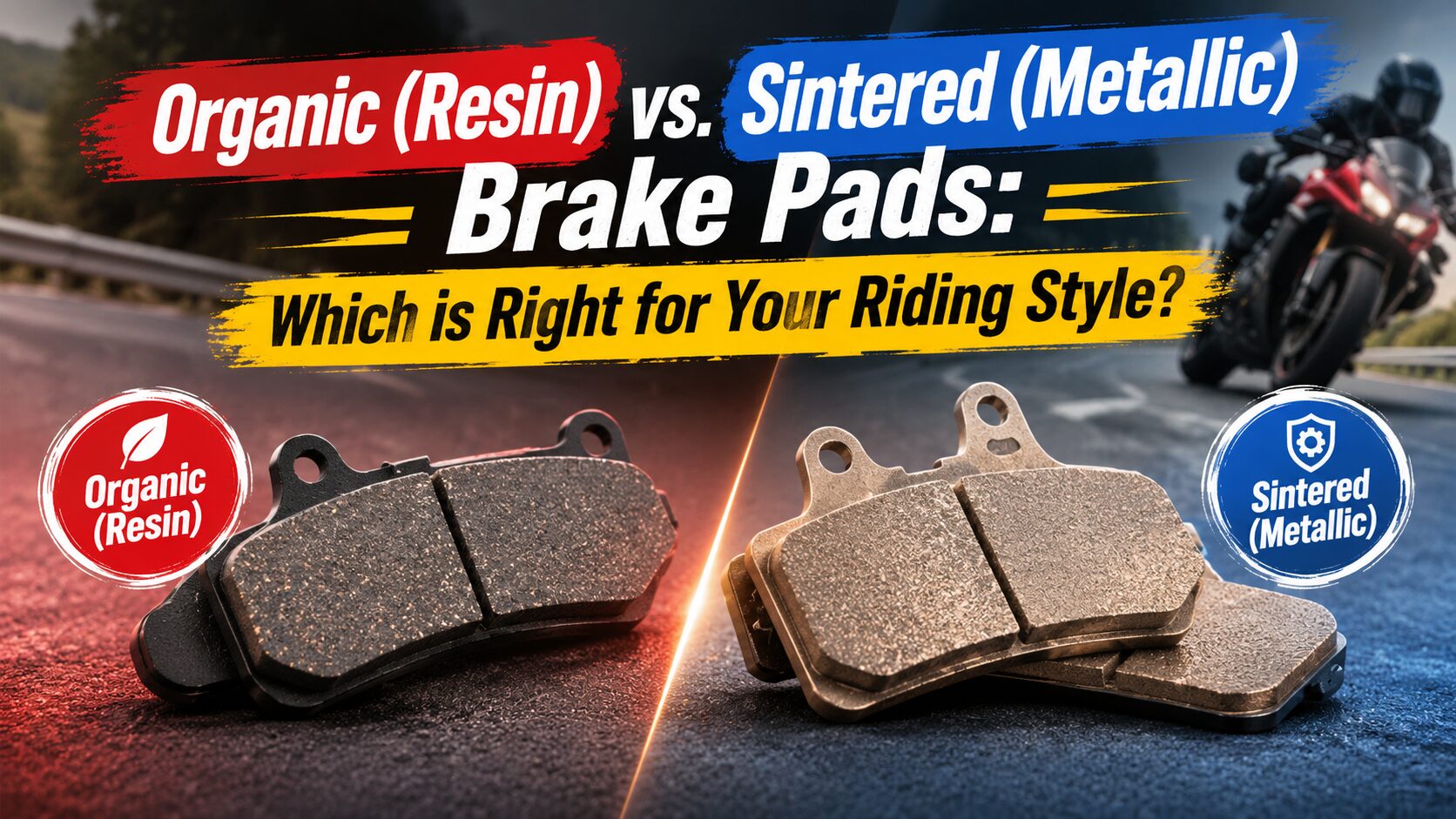
If you have ever stood in a bike shop staring at replacement disc brake pads, you have probably seen two labels: organic (resin) and sintered (metallic). They look the same on the outside.. On the road or trail, they feel and work in very different ways.
Picking between organic vs sintered brake pads is not about finding which one is “better” overall. It is about matching the pad material to how you ride, where you ride and in what weather. When you understand how each type works, you can stop safely, make noise and keep your rotors from wearing out too fast.
How Bicycle Disc Brake Pads Work
Each time you pull the brake lever, the caliper squeezes the pads on both sides of the rotating metal disc. The friction generated by the brake pads converts kinetic energy to heat and slows down the rotation of the wheel.
Since different materials react differently to heat, water, and pressure, the material used in bonding the steel backing plate alters the way your disc brake works.
What Are Organic (Resin) Brake Pads?
Organic pads often called resin pads are made from a blend of non-metallic fibers like rubber, glass, Kevlar, and carbon, all held together with a heat-resistant resin.
Key Advantages of Organic Pads
- Silent operation: These pads operate in a much more silent way than metallic pads, especially in dry weather conditions.
- Good braking from cold: The pads have a great ability to grip the rotor instantly and regardless of how cold the brakes are.
- Improved modulation: They provide a smoother and better feel of the lever and will allow you to control your speed without getting locked wheels.
- Kind to rotors: The softer compound makes them less aggressive for the metal brake rotors.
Drawbacks of Organic Pads
- Increased wear: This softer material will wear out faster, especially if you cycle in dusty, rainy, or muddy conditions.
- Heat effect: In long, steep downhill rides, heat can result in the resin glazing over, hence reducing the effectiveness of braking (brake fade).
What Are Sintered (Metallic) Brake Pads?
In addition, the construction of the sintered pads involves the compression of microscopic metallic dust particles including copper, iron, and bronze. The compression occurs under high temperatures and pressures.
Key Advantages of Sintered Pads
- Excellent thermal stability: They are capable of enduring long periods of braking on downward slopes without fading. Indeed, their performance becomes even better when they get hot.
- Performance in all weather conditions: It takes a lot of mud, rain, and debris to affect metal-based brakes, hence making them reliable in monsoons.
- Longevity: Sintered brake pads tend to last much longer due to hardness of the material.
Drawbacks of Sintered Pads
- Noisy performance: Squeaking is a common problem with metallic pads, particularly in cold and wet conditions.
- Increased rotor wear: With the hard metallic material, you can expect the rotors to wear out much quicker.
- Heat transfer: Metal is a good conductor of heat and hence passes on more heat to the brake fluid and caliper.
Organic vs. Sintered Brake Pads: Quick Comparison
| Feature | Organic (Resin) Pads | Sintered (Metallic) Pads |
| Noise Level | Very quiet | Louder, prone to squealing |
| Initial Bite | Immediate, even when cold | Needs slight warm-up for peak power |
| Wet/Muddy Performance | Fair (wears quickly) | Excellent and consistent |
| Heat Resistance | Moderate (can fade on long descents) | High (resists brake fade) |
| Pad Lifespan | Shorter | Longer |
| Rotor Wear | Low | Higher |
Which Pad Type Matches Your Riding Style?
Choose Organic (Resin) Pads If:
- You commute through dry conditions: For start-stop situations, low-speed braking that is both silent and immediate helps.
- You have road bikes and/or smooth cross-country trails: For situations where heat generation is low and braking happens quickly, organic pads will provide you with maximum control.
- Your rotors read “Resin Pad Only”: Some rotors found in cheaper models are made out of soft steel and cannot accommodate metallic pads. Be sure to check for the label on your rotors before switching pads.
Choose Sintered (Metallic) Pads If:
- You mountain bike or ride on downhills: Frequent and heavy braking produces high temperatures that metal pads can cope with easily.
- You ride an e-bike or transport bulky loads: Added mass translates into additional momentum to overcome, and softer resin pads get worn out pretty soon.
- You ride all year long in the rain and mud: In case wet conditions don’t make you stay indoors, sintered pads will help maintain your stopping power.
A Quick Note on Switching Pad Types
When you plan to change from using one type of pad (either organic or sintered) to the other, simply changing pads and hitting the road is not an option because of the residue left on the rotor surface by old pads. The best course is to clean your rotors before you put in the new pads with isopropyl alcohol or sanding, and remember to break in new pads using progressive braking.
Understanding when to replace brake pads and cleaning your rotors will help improve your brake life significantly.
Conclusion
At Sprandom, we know that choosing between organic and sintered brake pads comes down to your terrain, climate, and riding style. Organic brake pads are the best choice for commuters, road cyclists, and riders who stick to dry conditions, while sintered brake pads are built to endure tough terrains like steep downhills, wet trails, and heavy bikes. Make sure your rotors are compatible and that the compound suits your terrain, and you will see how your confidence improves with each pull of the lever.