




Imagine going downhill for miles and using your hand brakes in order to control the pace and be in charge. At first, you will feel strong braking and a sense of security, but when you get into the middle of the road, you have to work hard to produce the same braking effect because the lever becomes soft.
Heat is the cause of this dangerous reduction of braking effect called brake fade.Understanding what causes it and how quality brakes handle, it is essential for every cyclist’s safety.
Why Brakes Get So Hot: The Simple Physics
Each time you apply the brakes of a bike, an energy transformation is taking place. The energy of motion, known as the kinetic energy, exists in the form of motion. As per cycling brake physics, the friction between the braking surfaces and the brake pads transforms the kinetic energy directly into thermal energy heat.
One aspect about which most new cyclists are surprised is that if you double the speed of the bike, you are generating four times as much heat in your brakes. As kinetic energy depends on the square of your speed, braking at 40 kilometers per hour generates four times as much heat as braking at 20 kilometers per hour.
The Three Types of Brake Fade
When temperatures climb past what your brake components can handle, performance drops in one of three ways:
- Pad fade: Brake pads operate optimally within a particular temperature range. When the brake pad overheats, the binding resins in the pad start to deteriorate and produce a thin layer of gas. The gas creates an effective slippery barrier between the brake pad and the metal surfaces, and the result is that the rider will feel the brake lever being tight but the bike not slowing down.
- Fluid fade: In hydraulic disc brakes, heat generated by the brake pads can transfer through to the caliper and increase the temperature of the brake fluid. Once the brake fluid gets heated to its boiling point, bubbles form within the brake lines. Unlike the liquid, the gas can be compressed, and this will make the brake lever pull itself all the way back to the handlebar with minimal pressure.
- Glazing and deposit formations: Overheating can cause the formation of a hard and smooth glazing layer on the surface of the brake pad or the deposition of the brake pad material in patches on the metal surface of the disc.
How Quality Brakes Manage Heat Under Pressure
Stopping brake fade is not about applying greater pressure, but rather it is about retaining heat properly and getting rid of it as fast as possible into the air surrounding the braking system. This challenge can be met through proper design.
Ventilated disc rotor and caliper.
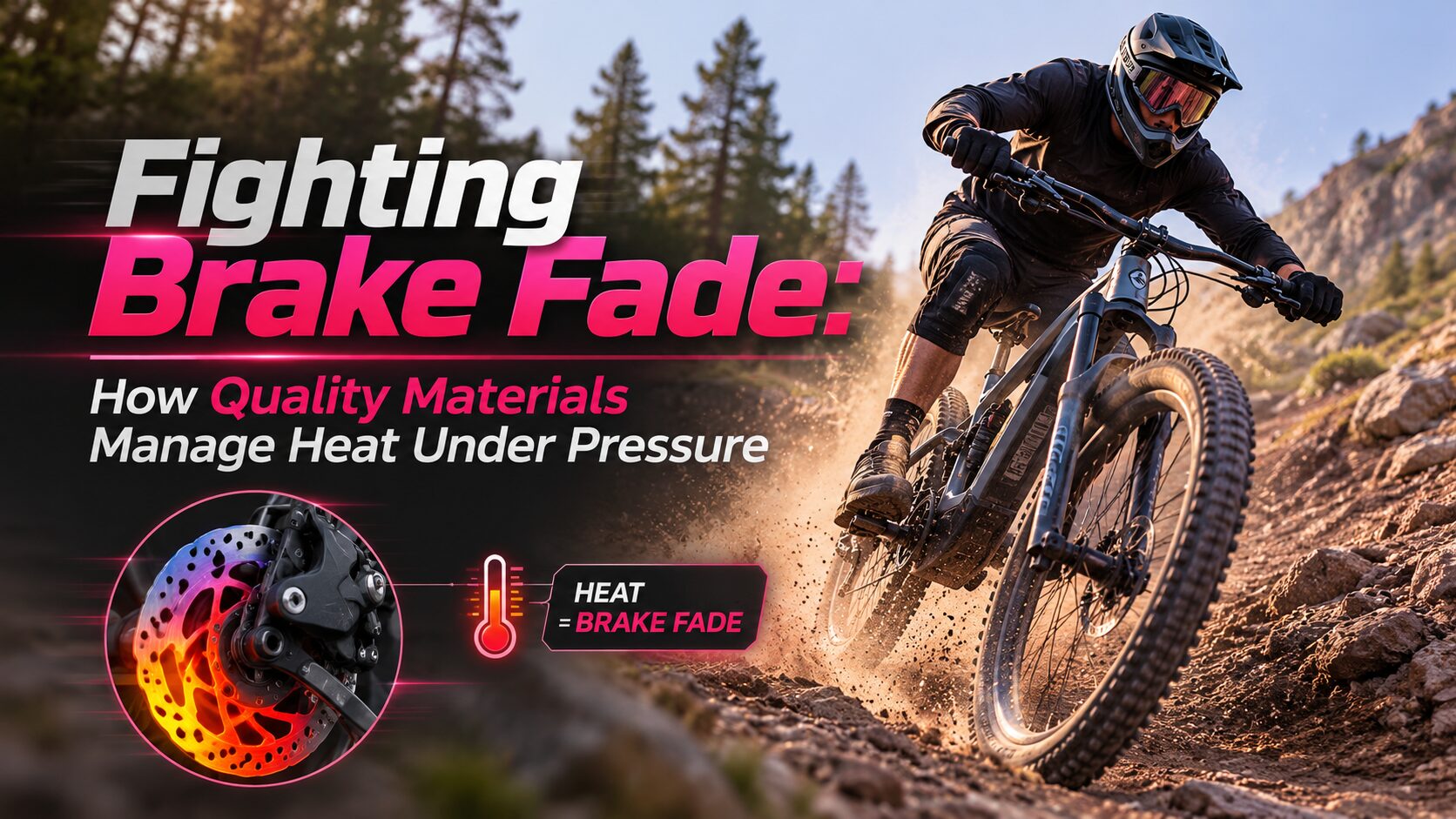
Look closely at the rotor in the image above. The evenly spaced cuts in the outer band serve not merely decorative purposes but also add to the surface area, allow air to flow through, and remove dust and heat from the metal so that the pad remains clean.
1. Brake Pad Compounds
Not all brake pads behave the same way when temperatures spike. Choosing the right pad material depends on how and where you ride:
| Pad Type | Core Material | Heat Resistance | Best Riding Use |
| Resin (Organic) | Soft fibers bound with resin | Low to moderate | Flat city roads, casual rides, quiet stops |
| Semi-Metallic | Resin mixed with metal fibers | Moderate to high | All-around commuting, hills, mixed weather |
| Sintered (Metallic) | Fused copper and metal particles | Very high | Steep descents, heavy loads, wet or muddy trails |
Resin pads grab quickly when cold and stay quiet, making them popular for everyday neighborhood riding. However, under sustained downhill heat, sintered metallic pads hold their friction much better because metal particles do not break down as early as organic resins.
2. Rotor Metals and Thermal Conductivity
Metal disc (rotor) experiences the greatest amount of heat generation during braking. Rotors are mostly made from hardened stainless steel which doesn’t rust, maintains its strength at higher temperatures, and offers consistent friction.
High-end rotors take this concept to another level by placing aluminum core between two layers of stainless steel. According to the principles of heat conduction, materials with better thermal conductivity quickly spread heat from hot spots. In other words, the aluminum alloy has a much higher thermal conductivity and rapidly draws heat from the braking surface and releases it to the atmosphere before pad overheats.
Another important factor that affects rotor efficiency is its diameter. The rotor with bigger diameter, for example, 180 mm rotor rather than 160 mm, means more metal mass to dissipate heat and larger surface area to be cooled after each squeeze. If you are just beginning to learn about disc brakes, rotor size in regard to rider weight and terrain type is the simplest way to prevent brake fade.
3. Rim Brakes vs. Disc Brakes Under Heat
The location of the brake itself plays a role too. Traditional V-brakes and caliper brakes apply rubber pads to the outer wheel rim. A correctly set-up V-brake operates efficiently under normal circumstances on level surfaces or during commuter rides.
On steep downhills on mountain passes, though, rim braking generates heat right into the wheel rim and the inner tube. Heat in excess will weaken the rim glue and increase the tire pressure. Bicycle disc brakes, by contrast, take the heat out of the equation by applying pressure to a separate metal rotor attached to the wheel hub. To learn more about different types of brakes, please check out our article below.
“Which Bicycle Brake is Better in 2026?”
4. Caliper Pistons, Fins, and Brake Fluid
When it comes to hydraulic systems, the objective is to prevent any heat from ever entering the liquid. Quality calipers make use of pistons made of either ceramics or phenolic due to their low heat conductivity as opposed to plain metal. There are some brake pads that have aluminum cooling fins which protrude into the air like small radiators to get rid of heat before it transfers to the caliper itself.
Another important aspect is precision manufacturing. International standards for bike safety require that the materials used in brakes be able to withstand friction heat without breaking or weakening structurally. This is done through consistent alloying, flat rotors, and quality control testing.
Practical Riding Habits to Prevent Overheating
Even the best hardware can overheat if you use the wrong braking technique. A few simple habits cut brake temperatures dramatically:
- Pulse instead of dragging: Braking hard throughout the whole descent will allow frictional heat to build up steadily. Instead, brake with force for a few seconds to scrub off some speed, and then fully release the lever to allow the cooling effect of wind flow.
- Utilize both brakes at the same time: Depending solely on the rear brakes will put all the effort into a small rotor. This method allows sharing the load and distributing the heat evenly between the rear and front brakes.
- Keep pads and rotors clean: Pads that are oily, covered in chain lube, or excessively dirty will lower the friction level. Consequently, more squeezing and generation of heat will be necessary for braking. It is recommended to wipe isopropyl alcohol onto the rotors and replace pads before they wear out.
- Change hydraulic brake fluid regularly: DOT brake fluid absorbs moisture from the environment and therefore has a reduced boiling point. Regular bleeding of hydraulic brake lines once in a couple of years prevents sudden boiling of the brake fluid.
Paying attention to these habits alongside key brake reliability factors keeps your braking smooth ride after ride.
Keeping Every Stop Predictable
When the rate of production of heat exceeds the rate of dissipation of heat by your bicycle, there will be brake fading. This means slipping brakes, boiled fluids or glazing of surfaces. Well-made brakes have control of heat in relation to pressure as a result of high temperature brake material, heat conduction and ventilation of rotors, caliper insulation and tight manufacturing tolerances. Combine Sprandom’s well-made brake components with good pulsing in downhill riding.