



If you’re thinking about using disc brakes for your bicycle, chances are that you’ve encountered two types – mechanical disc brakes and hydraulic disc brakes.
At first glance, they don’t seem so different. Both use a rotor, brake pads, and a caliper to slow down your bike. However, what makes them different is how the brake levers function.
A mechanical brake lever functions by means of a cable, while a hydraulic disc brake lever works by way of liquid pressure. This has effects on the efficiency of the braking system.
So, which is better for you?
How Do Mechanical Disc Brakes Work?
The mechanical disc brake relies on the conventional brake cable.
As the lever gets activated, it pulls the brake cable, which causes pressure to be applied to the braking mechanism inside the caliper, hence forcing the brake pad onto the rotor.
It is this simplicity that makes the mechanical brake system attractive since it allows the replacement of the brake cable when worn out.
However, cables can stretch, accumulate dust, and become sticky. In such a case, the brake won’t feel as sensitive as it used to be.
How Do Hydraulic Disc Brakes Work?
A hydraulic braking system, on the other hand, is a completely different case.
While mechanical brakes work without the use of hydraulic fluid, a hydraulic brake uses hydraulic fluid. As you pull the brake lever, the pressure created pushes the fluid into the brake hose and into the caliper where it pushes the pistons inside the calipers pressing the brake pads against the rotor.
This is how a hydraulic brake works smoothly.
They are easier to operate using the brake lever, especially over a long distance and while going downhill.
What’s the Actual Difference?
This difference can easily be defined as follows:
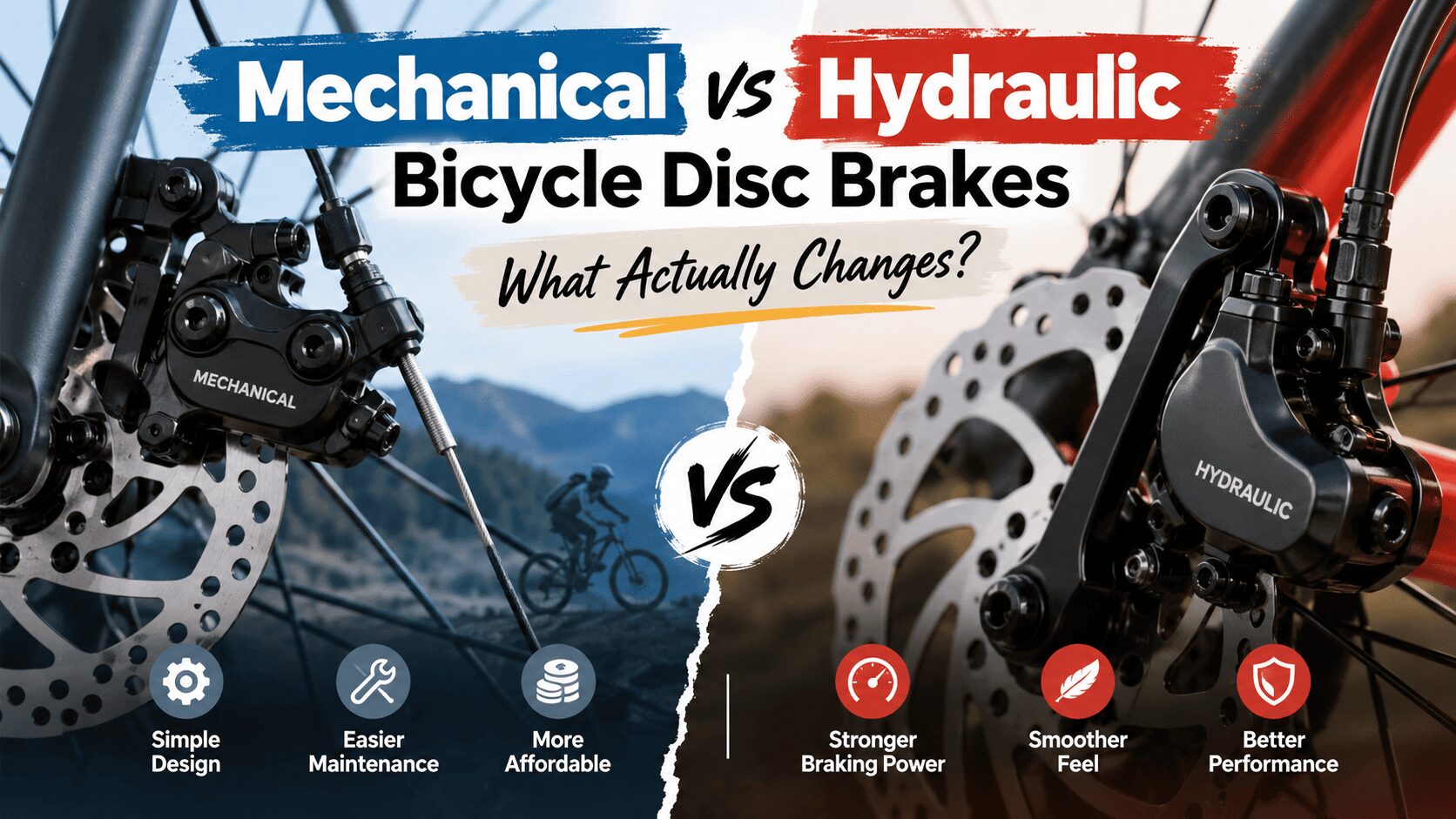
Mechanical brakes make use of a cable. Hydraulic brakes work on the basis of hydraulic pressure.
Though this single difference makes a considerable difference to the entire experience of riding a bike.
Hydraulic brakes are generally considered smoother and provide better control while making use of different brake forces. The mechanical brake system is considered slightly less effective, but a quality mechanical system will surely have enough stopping power.
In regular circumstances, there might not be much difference, but in case of steeper terrain or longer descent, this difference becomes quite clear.
What About Maintenance?
This is where mechanical brakes have an advantage.
Mechanical brakes are relatively easy to inspect and adjust. If the cable needs replacing, the job is usually simple and doesn’t require specialized equipment.
Hydraulic brakes don’t need cable adjustments, but they aren’t completely maintenance-free. From time to time, the hydraulic system may need servicing or bleeding, particularly if air gets into the system.
In other words, mechanical brakes are generally easier to repair, while hydraulic brakes tend to require less routine adjustment.
Which One Should You Choose?
Ultimately, it all depends on how you will use your bicycle.
In case you will use your bike to ride in the city and commute to work, it will be wise to go for mechanical disc brakes that are easy to maintain and operate.
But if you will ride on mountain terrains and you need to have good brake feel with minimal effort, then you should go for hydraulic disc brakes.
From the perspective of bicycle manufacturers, this is decided on considering certain things.
The Bottom Line
Mechanical and hydraulic disc brakes do the same basic job, but they go about it differently.
Mechanical brakes are simple and easy to maintain. Hydraulic brakes offer a smoother feel, lower lever effort and strong braking performance.
Neither choice is superior for all bikes. Everything is based on where you want to ride your bike, what purpose you have in mind, and what type of performance you expect from it.
But whatever braking system you select, quality parts and proper installation are very important for the performance of your braking system.