



In a country like India, your bike’s braking system is fighting two relentless enemies: extreme heat and pervasive humidity. If you ride a modern bicycle, your hydraulic disc brakes in India rely completely on a tiny reservoir of fluid to deliver that precise stopping power. But what’s inside that reservoir? Is it DOT Fluid or Mineral Oil?
Choosing the wrong fluid, or neglecting the one you have, can lead to the terrifying experience of “brake fade” where your levers pull to the bar but nothing happens. As one of the Best Bicycle Brakes Manufacturer in Ludhiana, we know this is a matter of safety, not just performance. The tropical, humid climate here severely challenges one type of fluid much more than the other. Let’s break down this critical choice.
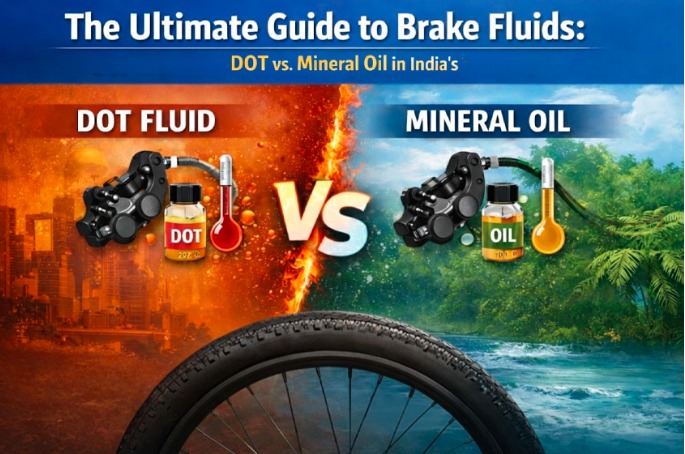
The DOT Fluid Challenge: The Hygroscopic Headache
DOT fluid (Department of Transportation), such as DOT 4 or 5.1, is the performance choice for many systems. However, its chemical nature presents a major liability in humid environments: it is hygroscopic.
Hygroscopic means the fluid actively absorbs moisture from the atmosphere. In India’s monsoons and high humidity, this process is dramatically accelerated. Why is this bad? Water drastically lowers the fluid’s boiling point. For example, fresh DOT 5.1 fluid boasts a dry boiling point of around 270°C. Once it absorbs just a small percentage of water (“wet boiling point”), that threshold can plummet to roughly 190°C.
When you ride hard, navigating city traffic with constant braking, or tackling a long, hot descent the brake caliper generates immense heat. If that heat reaches the compromised, lowered boiling point of the fluid, the water inside vaporizes, creating gas bubbles. Since gas is compressible, your lever instantly turns to mush. That’s a vapor lock, and you lose your brakes. This acute risk means you must commit to bleeding DOT systems much more frequently here than in dry climates to maintain safety.
The Mineral Oil Advantage: Stable and Safe
Mineral Oil (used by brands like Sprandom) is chemically opposite to DOT fluid: it is hydrophobic, meaning it does not absorb water. This non-hygroscopic nature is a huge win for riders in humid India. The fluid’s performance doesn’t degrade over time simply due to atmospheric moisture absorption, allowing high-quality mineral oils to maintain their high dry boiling point consistently. Furthermore, Mineral oil is non-corrosive. It won’t damage your bike’s paint or compromise the seals in your braking system, leading to longer component life and less maintenance fuss.
There is a catch, however. While it doesn’t absorb water, any moisture that enters the system will not mix with the oil. Instead, it pools at the lowest point, the caliper. This pooled water can boil at just 100°C, causing a sudden, localized failure.
Final Verdict for Tropical Riding
For long-term reliability and lower maintenance in India’s tough, humid conditions, high-quality Mineral Oil systems often offer a safer, more stable solution for the average cyclist due to their stable boiling point. However, both systems demand attention.
No matter your fluid, remember two golden rules: First, Never Mix – DOT fluid will destroy the seals in a Mineral Oil system, and vice-versa. Always use the manufacturer-specified fluid. Second, Bleed Regularly Even Mineral Oil systems need annual service to remove any pooled water. DOT systems in India’s climate benefit from 6-month checks to refresh the fluid and restore its high dry boiling point.
Your safety starts with understanding what’s in your brake lines. Choose systems engineered to handle the heat.