



The Rising Demand for Mechanical Disc Brake Conversion
The technology of bicycle riding evolving, an increasing number of riders and bike manufacturers are moving towards conversion to mechanical disc brakes to enhance their stopping power and performance in all weather conditions. When refitting older rim-braked bicycles or setting up new bikes, it is imperative to know the mechanics behind the pull ratios and cable efficiency in attaining professional level braking.
Understanding Pull Ratio in Braking Systems
Pull ratio is defined as the ratio between the distance that a brake lever is moved to and the distance a brake caliper activates. In less technical language, it is the measure of how long a cable your lever is pulling compared to the amount of motion at the caliper end.
The average road lever is 2:1 and the average mountain bike lever is 1.8:1. Converting to mechanical disc brakes, the mismatch between the pull ratios of levers and calipers is a source of weak braking or bottoming out of the lever without sufficient pad contact. This is essential to ensure optimal modulation and stopping power.
Cable Efficiency: The Hidden Performance Factor
Cable efficiency measures how effectively force transfers from the lever through the cable housing to the caliper. Friction, housing compression, and cable routing all impact this efficiency. Poor cable runs with excessive bends create friction that robs braking power and creates a spongy feel.
Quality cable housing with proper liner materials, smooth routing with minimal bends, and regular maintenance dramatically improve cable efficiency. Even the best mechanical disc brake system underperforms with compromised cable paths.
Common Problems in Poor Brake Conversions
The relationship between the distance that a brake lever is moved and the extent to which the brake caliper is actuated is known as pull ratio. In simple terms, it will decide the degree of cable your lever will pull and the degree of movement at the caliper end.
The normal road lever is 2:1 and mountain bikes are about 1.8:1. In converting to mechanical disc brakes, the use of incorrect pull ratios between levers and calipers causes either weak braking or bottoming out of the lever, without sufficient pad contact. This match is essential in the achievement of the best modulation and stopping power.
Maximising Pull Ratio and Cable Efficiency: Practical Tips
- Begin with ensuring that the brake levers and calipers are compatible. Manufacturers or use of match pull ratios have adjustable mechanisms where possible.
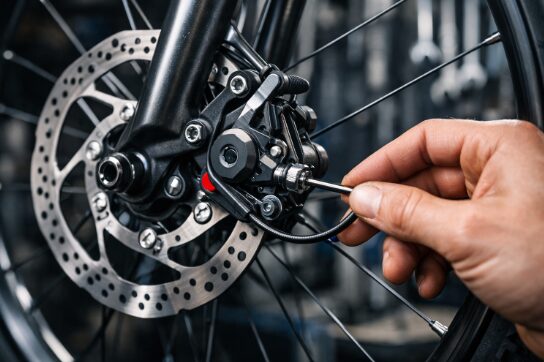
- Install high-quality compressionless brake housing that is specific to mechanical disc systems. Cables used on routes have the minimum number of bends with sharp angles that generate friction to be avoided. Install correct cable ferrules; make sure housing cuts are clean and square.
- Periodic maintenance such as replacement of cables, inspection of houses and caliper adjustment ensures that systems operate at optimal performance. Last, select brake parts among proven manufacturers that design systems with specifications that match.
Engineering Excellence in Mechanical Disc Brakes
Being a major producer of bicycle brakes in India, we have created a precision-engineered brake system that deals with these vital performance aspects. Our mechanical disc brakes have an optimised pull ratio, smooth caliper actuation, and the ability to use standard cable systems.
We have been a reputable bicycle disc brake exporter because of our decades of experience in manufacturing and quality control. Being a manufacturer of bicycle brake parts, we realize that it is a safety issue that the stopping power remains constant.
Why Global Markets Trust Indian Manufacturing
Indian manufacturers blend the old with the new manufacturing technology. Our products are the favorite of distributors and OEM manufacturers around the world because of export-quality standards, competitive prices, and the capacity to satisfy international certifications.
We have a strong dedication to precision engineering and all our components are of high performance standards as required by the global markets.
Choose Quality for Reliable Braking Solutions
You may be a bicycle manufacturer in need of reliable parts or a mechanic who needs to upgrade your customers’ bikes with mechanical disc brakes, either way, good parts that have been designed to perform are required. Enhance our product line of mechanical disc braking systems that have been developed to be durable, safe and of high stopping power.