




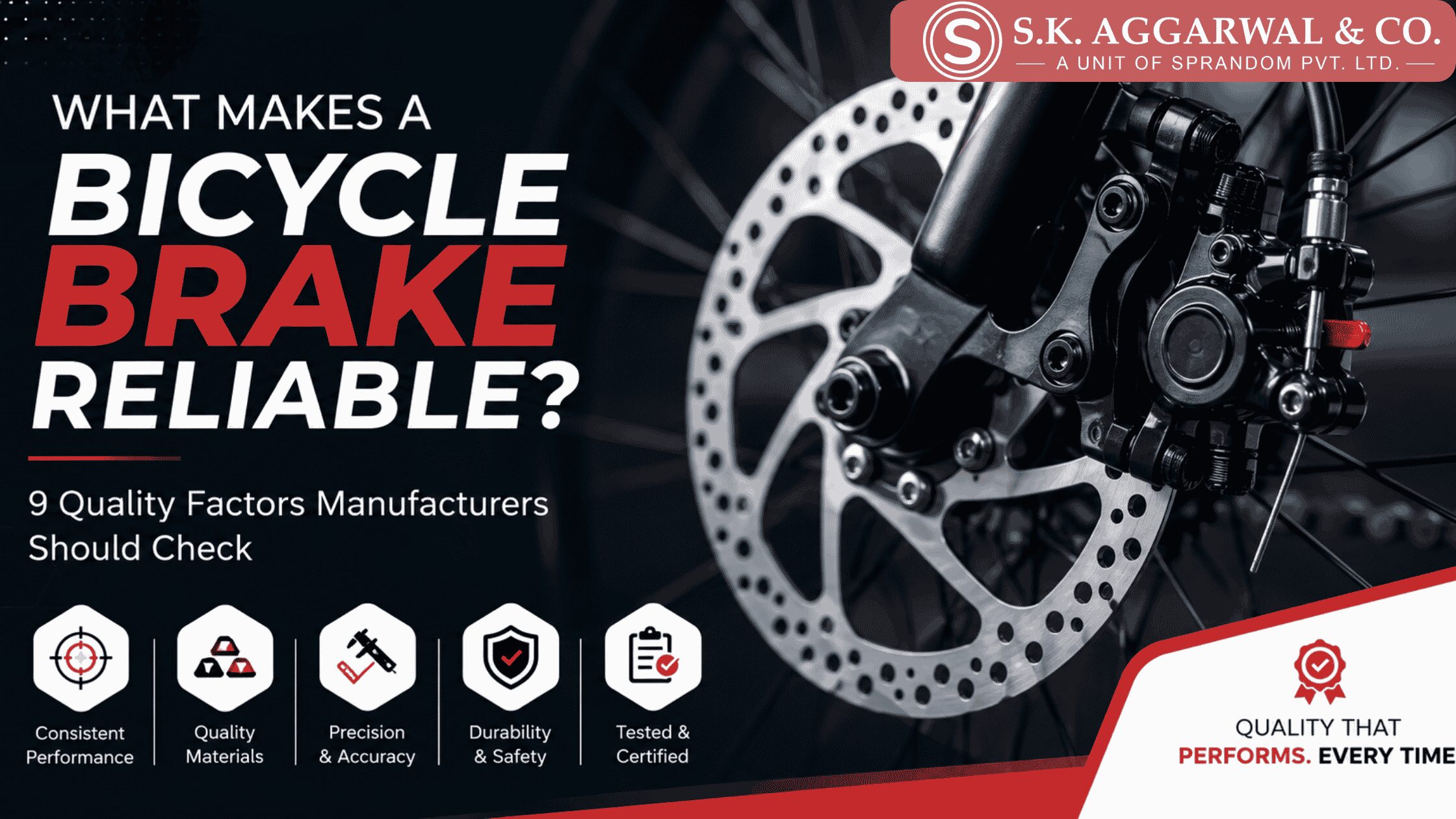
Although the bicycle brake is very simple in design, its efficiency relies on far more than just that. Quality of materials used, dimension accuracy, brake efficiency, assembly, and testing are some of the factors that help in ensuring reliability.
For bicycle manufacturers, distributors and bulk buyers, selecting a reliable brake supplier is therefore an important decision. The brake must work consistently with the bicycle on which it is installed and should be manufactured under controlled quality processes.
At S.K. Aggarwal & Co., manufacturer of bicycle brakes under the Sprandom brand, quality is an important part of the manufacturing process. The firm produces various braking parts for bicycles such as disc brakes, V brakes, caliper brakes, brake levers, brake shoes and other accessories. According to its products list, S.K. Aggarwal & Co. is certified as an ISO 9001:2018 company.
Now, what do manufacturers need to consider when assessing reliability of a bicycle brake?
1. Consistent Braking Performance
Brake system must be consistent and give predictable braking response when brake is activated by rider.
Braking on bicycle constitutes a system where various components like brake lever, cable/hydraulic system, brake unit, pads, rotor or rim are used. Even one component not functioning properly may affect the overall braking performance.
Recognized bicycle standards include specific braking requirements and test methods. ISO 4210-4:2023 specifically covers braking test methods associated with ISO 4210-2.
At S.K. Aggarwal & Co., quality checks and manufacturing controls are used to maintain consistency across bicycle brake products.
2. Correct Material Selection
Material selection has a direct influence on the performance and durability of bicycle brake components.
Depending on the component, manufacturers need to consider:
- Strength
- Durability
- Wear resistance
- Corrosion resistance
- Friction characteristics
- Weight
- Surface finish
- Intended application
Different bicycle brake designs can have different requirements, so material selection should be based on the purpose and operating conditions of the product. Consistency in the materials used is equally important for maintaining quality between production batches.
3. Dimensional Accuracy and Alignment
A well-designed brake can still perform poorly if its components are not manufactured to the required dimensions.
Important areas can include:
- Component dimensions
- Mounting-hole positions
- Thread dimensions
- Brake-arm geometry
- Pivot areas
- Pad-holder dimensions
- Clearances
- Assembly tolerances
Correct alignment is also essential. The brake needs to be positioned properly in relation to the braking surface. Manufacturing quality should therefore involve dimensional control rather than relying only on final visual inspection.
4. Brake Pad and Friction-Surface Quality
Brake pads and braking surfaces are directly involved in creating braking force, making their quality particularly important.
Manufacturers should pay attention to:
- Friction-material consistency
- Pad dimensions
- Secure attachment
- Surface condition
- Pad alignment
- Wear characteristics
- Compatibility with the intended braking surface
Clean manufacturing and careful handling are also important because contamination can affect braking surfaces. The aim is not simply high friction, but predictable performance within the intended application.
5. Heat Management
Braking converts kinetic energy into heat. Repeated or prolonged braking can therefore increase the temperature of braking components.
Heat behaviour can be influenced by:
- Brake design
- Rotor design
- Brake-pad material
- Component size
- Airflow
- Bicycle application
- Frequency of braking
- Duration of braking
A brake should be designed according to the conditions in which it is expected to operate. Different bicycle applications may require different braking solutions.
6. Secure Mounting and Strong Components
A reliable brake must remain securely attached to the bicycle.
Mounting points, fasteners, brackets, brake arms and other structural components all contribute to overall reliability.
Indian bicycle safety requirements cover areas such as brake-lever dimensions, brake-assembly attachment, brake-block assembly, brake adjustment and braking performance. BIS documentation for IS 10613 also identifies braking-related testing and production controls.
Manufacturers should therefore check:
- Fastener quality
- Thread quality
- Mounting dimensions
- Component strength
- Assembly accuracy
- Proper tightening
- Secure attachment
- Repeatability
7. Efficient Force Transfer
When a rider operates the brake lever, the applied force needs to reach the braking mechanism efficiently.
For mechanical systems, this includes components such as the brake lever, cable and housing. Manufacturers should consider cable movement, routing, compatibility, connection points, lever movement, friction and adjustment.
A carefully manufactured brake can only perform as intended when its operating components are correctly matched and assembled.
8. Resistance to Wear, Corrosion and Contamination
Bicycle brakes can be exposed to dust, water, road dirt, humidity and repeated mechanical movement.
Reliable products therefore need to account for their intended operating environment.
Quality considerations may include:
- Corrosion resistance
- Surface treatment
- Suitable materials
- Protective packaging
- Clean handling
- Wear characteristics
- Environmental exposure
Wear should remain controlled and predictable, while manufacturing and handling should help prevent contamination of important braking surfaces.
9. Quality Control and Repeatability
A reliable design is only valuable when a manufacturer can reproduce the same quality consistently.
A proper quality-control process can include:
Raw Material Checks
Incoming materials and components are checked against defined requirements.
Dimensional Inspection
Critical dimensions are measured against specified tolerances.
Assembly Inspection
Components are checked for correct positioning and secure assembly.
Functional Checks
Completed brakes are checked for correct operation.
Performance Testing
Where applicable, braking performance is evaluated according to relevant requirements, standards or customer specifications.
Final Inspection
Finished products are inspected before packing and dispatch.
Production Records
Quality documentation helps maintain consistency and traceability.
For S.K. Aggarwal & Co., quality management is an important part of manufacturing, and the company’s product catalogue identifies it as an ISO 9001:2018 certified company.
Bicycle Brake Testing and Indian Standards
Quality testing is more than checking whether a brake looks correctly assembled.
The IS 10613:2023 standard covers safety and performance requirements for bicycles and includes braking-related requirements. BIS documentation lists checks involving brake-lever dimensions, brake-assembly attachment, brake-block assembly, brake adjustment, strength of hand-operated brakes and braking under dry and wet conditions.
At the international level, ISO 4210-4:2023 specifies braking test methods associated with ISO 4210-2.
These standards demonstrate the importance of structured testing and quality control rather than relying only on visual inspection.
At S.K. Aggarwal & Co., our manufacturing and quality processes focus on producing bicycle brake components with consistent specifications and dependable performance.
Why Quality Matters for Bicycle Manufacturers
A bicycle brake is part of a complete bicycle system. It needs to work correctly with the frame, fork, wheel, rim or rotor, brake lever, cable system and related components.
When evaluating a bicycle brake manufacturer, buyers should consider:
- What materials are used?
- What manufacturing controls are followed?
- How are critical dimensions checked?
- What quality tests are performed?
- How is batch consistency maintained?
- What standards or specifications apply?
- Can the manufacturer supply the required volume consistently?
- Can the supplier provide technical specifications?
These questions help manufacturers make more informed purchasing decisions.
Why Choose S.K. Aggarwal & Co. for Bicycle Brakes?
S.K. Aggarwal & Co., operating under the Sprandom brand, manufactures a range of bicycle brake products and related components, including:
- Disc Brakes
- V/Cantilever Brakes
- Caliper Brakes
- Brake Levers
- Kids Brake Levers
- Brake Shoes and Accessories
The company’s published product catalogue identifies S.K. Aggarwal & Co. as an ISO 9001:2018 certified company and gives its manufacturing location as Ludhiana, Punjab, India.
For bicycle manufacturers, distributors and bulk buyers looking for bicycle brake components from India, S.K. Aggarwal & Co. offers a range of products supported by established manufacturing experience and quality-focused production practices.
Final Thoughts
The manufacture of reliable bicycle brakes is based on a combination of many factors.
These include appropriate materials and engineering, proper manufacturing, dimensional checks, assembly and performance tests.
Therefore, manufacturers of bicycles should not consider only looks and cost while analyzing bicycle brakes.
Reliability means that all manufacturing processes should be consistent and of high quality.
At S.K. Aggarwal & Co., we always pay attention to these criteria in the process of production of bicycle brakes and parts for them under the brand name of Sprandom.
Frequently Asked Questions
What makes a bicycle brake reliable?
A reliable bicycle brake combines suitable materials, accurate dimensions, dependable friction characteristics, secure mounting, effective force transfer, resistance to expected wear and consistent manufacturing quality.
How are bicycle brakes tested?
Testing depends on the product, bicycle application and applicable requirements. Bicycle standards such as IS 10613 and ISO 4210 include braking-related requirements and test methods.
Why is dimensional accuracy important?
Accurate dimensions help components fit, align and operate as intended. Manufacturing tolerances are especially important for mounting points, moving components and pad positioning.
Does material quality affect brake performance?
Yes. Material selection can influence strength, durability, friction, wear and corrosion resistance.
Why should manufacturers check quality-control processes?
Consistent quality is essential for bicycle production at scale. A controlled quality process helps keep different production batches within required specifications.
Is S.K. Aggarwal & Co. ISO certified?
The company’s published product catalogue identifies S.K. Aggarwal & Co. as an ISO 9001:2018 certified company.
Where is S.K. Aggarwal & Co. located?
S.K. Aggarwal & Co. is based in Industrial Area-C, Sua Road, near PSPCL Substation, Kanganwal, Ludhiana, Punjab, India – 141017.
What types of bicycle brakes does S.K. Aggarwal & Co. manufacture?
The company’s published product range includes disc brakes, V/Cantilever brakes, caliper brakes, brake levers, kids’ brake levers, brake shoes and related bicycle brake accessories.